Two 3-minute rounds with a 60-second rest between them.
20 secPin to win
Hold a dominant position your opponent cannot improve from for 20 seconds and the match is over.
TapAll submissions legal
A tap or a verbal submission wins at any point. Tap before an injury happens.
2 / 3 / 5Takedown points
Takedowns and throws are scored on amplitude. Feet over the head is worth 5.
NoGuard pulling
Pull guard without a sweep or dominant position and you give up the takedown points.
4 ptsPassivity ends it
Give your opponent 4 passivity points and the referee stops the match.
FRCS vs. Typical Grappling Rules
Situation
Typical submission grappling
FRCS rules
Holding someone down
Earns points, the match continues
20 seconds in a dominant position wins the match
Pulling guard
Allowed with no penalty
Concedes the takedown points unless it ends in a sweep or dominant position
Big throws
Usually worth the same as any takedown
Scored 2, 3 or 5 points on amplitude
Advantages
Often decide close matches
Not used
Stalling and butt scooting
Warnings, sometimes penalties
Stand-up, warning, then points to the opponent. 4 points ends the match
Escaping to your feet
No points
1 point
01 Philosophy
No competitor should be able to win by managing the clock or collecting advantages. Winning has to be clear and decisive. To win, you dominate and control your opponent.
FRCS encourages athletes to be exciting: takedowns, throws, positional control, fast transitions and submissions. There is no guard pulling and no butt scooting. Playing guard on the way to victory is fine, but it is not rewarded as a dominant position.
Think about police officers, the military, firefighters and first responders. Not being on your back can save a life, and the rules are written with that reality in mind.
02 Time Limits
All matches are 6 minutes long, split into two 3-minute rounds with a 60-second rest between rounds.
If there is no pin, submission or verbal tap when time runs out, the competitor with the most points wins.
03 Ways to Win
By pin
Hold your opponent for 20 seconds in a position they cannot improve from and you win the match. Pins that count:
Past the guard with your opponent's shoulders on the mat.
Mount held without losing the position.
Back control with both hooks in, opponent stretched out and belly down.
Knee on belly maintained.
By submission
A tap or verbal submission wins. All submissions are legal. It is each competitor's responsibility to tap before an injury.
By points
The competitor with more points when time runs out wins. If the score is tied, the referee and the two side judges each show the card for the corner they pick as the winner. A unanimous or 2 to 1 majority decides the match.
04 Super Matches
If a super match ends in a draw, two 90-second sudden-death overtime rounds follow. The first takedown of any kind followed by control wins. If there is still no winner, the three officials decide by majority or unanimous decision.
05 Technical Stoppage
If a competitor cannot continue because of injury, impact, dizziness or loss of consciousness, the match ends by technical stoppage and the win goes to the opponent who can continue.
After a hard throw, the referee may give a standing 8 count to check whether the athlete can continue. A 10 count ends the match. These rules exist to protect athletes from further injury.
06 Fouls and Illegal Techniques
No eye poking or gouging
No headbutts, standing or on the ground
No fish-hooking
No fingers in any opening of the opponent's body
No intentional knees, shins or feet to the groin
No excessive cuffing or slapping to the head, ears or neck
No elbows, knees or strikes of any kind
No shin kicking. Leg attacks and foot sweeps must be made with intent to score a takedown and while engaged
No stomps or direct attacks to the knee. Kani basami and other leg attacks are permitted
07 Scoring
Points reward skill, amplitude and control. After a takedown, the referee watches for control and domination points.
Move
Points
Takedowns and throws
Simple takedown, dump, trip or fall to a dominant position
2
Skillful takedown where both of the opponent's feet leave the ground
3
Masterful throw where the opponent's feet go over their head (suplex, judo throws, sacrifice throws)
5
Ground control
Escape from an inferior position back to your feet
1
Sweep or reversal from an inferior to a dominant position
2
Passing the guard
3
Mount held for 2 seconds
4
Taking the back with hooks in
4
Knee on belly
Held for a 3 count
2
Held for a 5 count
3
Held for 20 seconds
Pin
08 Passivity, Guard Pulling and Butt Scooting
Every guard pull must come with intent to attack, score or pressure. Flying triangles, flying armbars and sacrifice throws are not treated as passive guard pulls, even if they do not finish.
A competitor who pulls guard concedes the takedown points unless the pull ends in a sweep or a dominant position. Two or three scoots are allowed depending on the athlete's willingness to engage, at the referee's discretion.
First time Stand-up
Second time Warning
Third time 1 point to the opponent
4 passivity points Match over by referee stoppage
If the standing athlete does not want to engage a seated opponent, the referee brings the seated athlete back to their feet. The standing athlete must back away to allow it.
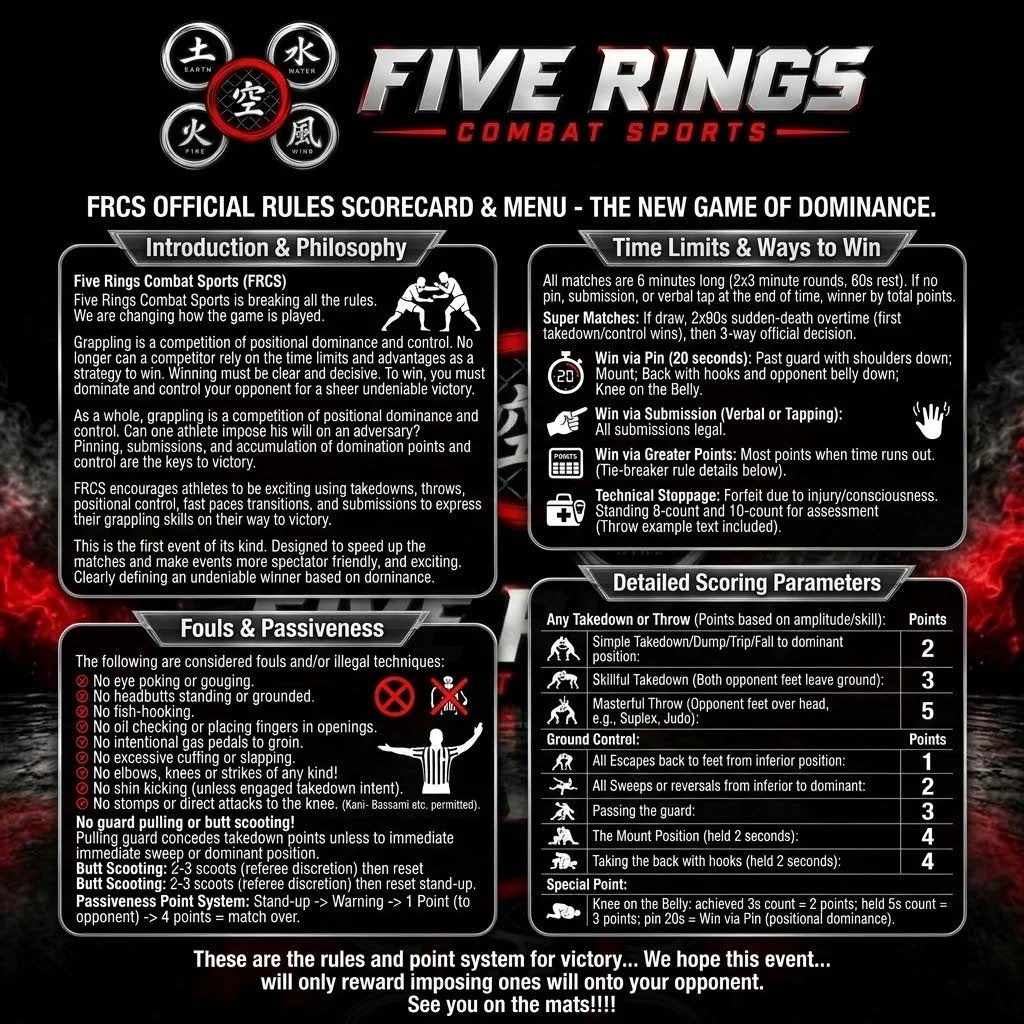
Official rules scorecard. Tap to open full size, or print it for your gym.
Ready to Test the Rules?
Register for FRCS 1 or send us your questions about the format.